### The Context & Accountability Layer for AI Systems
**Auditable · Governed · Explainable · Production-Ready**
[](https://pypi.org/project/semantica/)
[](https://pepy.tech/project/semantica)
[](https://www.python.org/)
[](https://opensource.org/licenses/MIT)
[](https://github.com/semantica-agi/semantica/actions)
[](https://discord.gg/sV34vps5hH)
[](https://docs.getsemantica.ai/)
**[Website](https://getsemantica.ai/)** · **[Docs](https://docs.getsemantica.ai/)** · **[Discord](https://discord.gg/sV34vps5hH)** · **[Twitter/X](https://x.com/BuildSemantica)** · **[YouTube](https://www.youtube.com/watch?v=QfnNZg4-dZA)** · **[PyPI](https://pypi.org/project/semantica/)** · **[Changelog](CHANGELOG.md)**
> Most AI agents act without a trail.
>
> They store embeddings, not meaning. They make decisions that cannot be audited, recall context that cannot be explained, and produce outputs that cannot be traced back to a source. Regulators, auditors, and enterprise risk teams are asking the same question: **can you prove what your AI did and why?**
>
> Semantica is the **Context and Accountability Layer** that sits alongside your LLM and vector store — adding structured intelligence, causal reasoning, and a full audit trail to every decision your agents make.
**Core capabilities:**
- **Context Graphs** — structured, queryable graph of everything your agent knows, decides, and reasons about
- **Decision Intelligence** — every decision is a first-class object: traceable, searchable by precedent, causally linked
- **AI Governance** — policy enforcement, SHACL constraints, conflict detection, and compliance rule checks built in
- **Full Auditability** — W3C PROV-O provenance on every fact; audit trail exportable to JSON, CSV, or RDF
- **Reasoning Engines** — forward chaining, Rete network, Datalog, SPARQL — explainable paths, not black boxes
- **Drop-in Integrations** — Agno native, 12-tool MCP server, 50+ CLI commands, 109 REST endpoints, plugins for 8 editors
**[Quick Start](#quick-start)** · **[Why Semantica](#why-semantica)** · **[Architecture](#architecture)** · **[Context Graphs](#context-graphs)** · **[Decision Intelligence](#decision-intelligence)** · **[Module Showcase](#module-showcase)** · **[CLI](#cli)** · **[Integrations](#integrations)** · **[Performance](#performance)** · **[Install](#installation)**
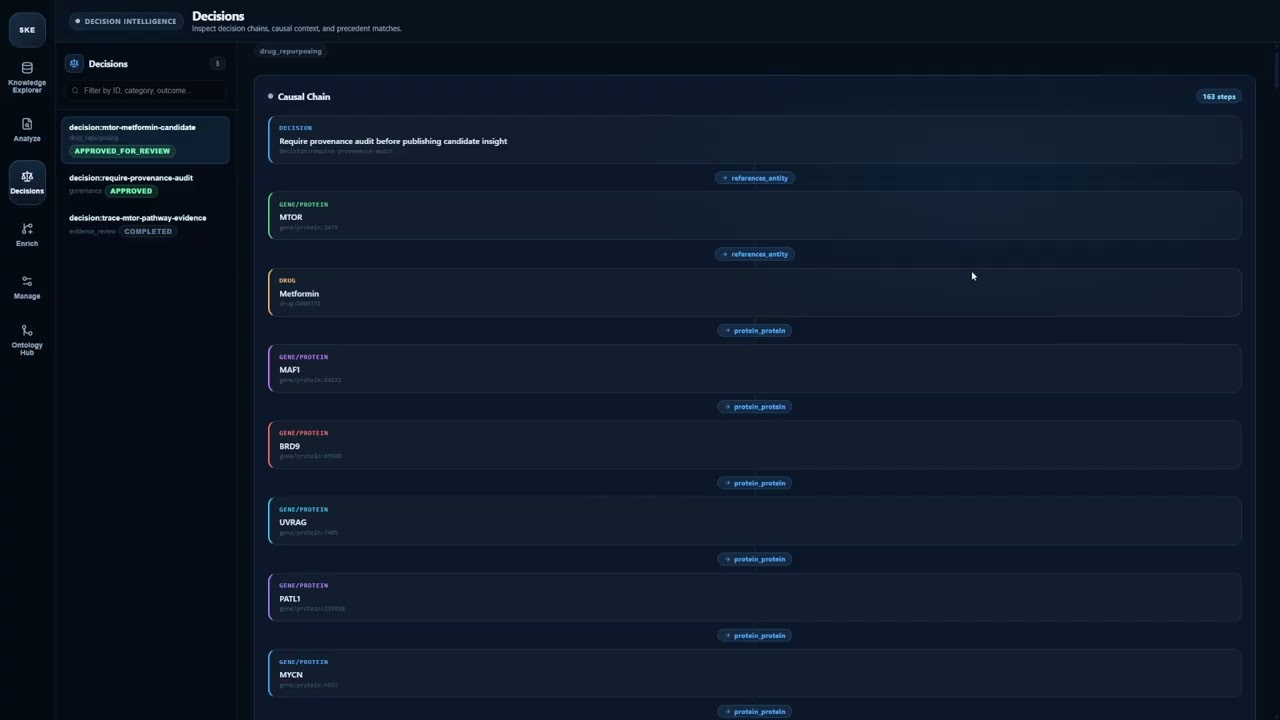
## See It in Action
**[Watch the full platform walkthrough →](https://www.youtube.com/watch?v=QfnNZg4-dZA)**
*Knowledge Explorer · Context Graphs · Reasoning Engine · Decision Intelligence · Ontology Hub*
## Quick Start
```bash
pip install semantica
```
```python
from semantica.context import ContextGraph
graph = ContextGraph(advanced_analytics=True)
# Every agent decision becomes a queryable, auditable knowledge node
decision_id = graph.record_decision(
category="vendor_selection",
scenario="Choose cloud provider for HIPAA workload",
reasoning="AWS offers BAA, mature HIPAA tooling, and existing team expertise",
outcome="selected_aws",
confidence=0.93,
)
# Ask "why did this happen?" and get a real, structured answer
chain = graph.trace_decision_chain(decision_id) # full causal ancestry
similar = graph.find_similar_decisions("cloud vendor", max_results=5) # precedents
impact = graph.analyze_decision_impact(decision_id) # downstream influence map
compliant = graph.check_decision_rules({"category": "vendor_selection"}) # policy check
```
If Semantica solves a real problem for you, a star helps others find it.
**[⭐ Star on GitHub](https://github.com/semantica-agi/semantica)** · **[Join Discord](https://discord.gg/sV34vps5hH)**
## Why Semantica
| | Vector DB + RAG | Plain LLM Memory | **Semantica** |
| --- | --- | --- | --- |
| **Recall method** | Embedding similarity | Token window | Graph traversal + semantic search |
| **Decision history** | Not stored | Not stored | First-class queryable objects |
| **Provenance** | None | None | W3C PROV-O, source-linked |
| **Reasoning** | None | Black box | Forward chain, Rete, Datalog, SPARQL |
| **Conflict detection** | Silent overwrite | Silent overwrite | Detected, flagged, resolved |
| **Time travel** | No | No | Point-in-time graph snapshots |
| **Compliance export** | None | None | PROV-O, SHACL, OWL, RDF |
| **Policy enforcement** | None | None | Built-in rule engine + SHACL |
| **Entity resolution** | No | No | Blocking + semantic deduplication |
| **Multi-agent context** | Separate per agent | Separate per agent | Single shared intelligence layer |
Semantica does not replace your LLM or your vector store — it adds the structured intelligence and accountability layer they cannot provide.
## Context Graphs
A Context Graph is the structured memory layer that traditional RAG is missing. Instead of flat embeddings that answer *"what is similar?"*, a Context Graph answers *"what is connected, why, and how?"*
Every entity, relationship, decision, and fact is a first-class node — queryable by graph traversal and neighbor expansion. Entities link to source documents. Decisions link to evidence and consequences. Facts carry full provenance. Conflicts are detected, not silently overwritten.
```python
from semantica.context import ContextGraph, AgentContext
from semantica.vector_store import VectorStore
graph = ContextGraph(advanced_analytics=True)
# Add nodes and typed edges
graph.add_node("acme_corp", "Organization", name="Acme Corp", industry="SaaS")
graph.add_node("alice_chen", "Person", name="Alice Chen", role="CTO")
graph.add_node("contract_001", "Contract", value=2_400_000, currency="USD")
graph.add_edge("alice_chen", "acme_corp", edge_type="works_for", since="2019-03-01")
graph.add_edge("acme_corp", "contract_001", edge_type="party_to", signed="2024-01-15")
# Graph traversal — hop through the graph from any node
neighbors = graph.get_neighbors("acme_corp", hops=2)
# Point-in-time snapshot — the graph as it existed on a past date
snapshot = graph.state_at("2024-01-01")
# AgentContext — high-level API for agent memory workflows
vs = VectorStore(backend="faiss")
ctx = AgentContext(vector_store=vs, knowledge_graph=graph)
ctx.store("Alice approved the Acme renewal in Q1 2024", conversation_id="conv_001")
retrieved = ctx.retrieve("who approved the Acme contract?")
```
**Why graph over embeddings:**
- Traversal finds connections embeddings miss — a person 3 hops from a contract
- Every node carries provenance — you can always ask *"where did this come from?"*
- Conflicts are detected and flagged before they corrupt your knowledge base
- Point-in-time snapshots let you replay history without reprocessing
## Decision Intelligence
Decision Intelligence turns every AI choice from an ephemeral inference into a permanent, auditable, queryable record. It answers *"what did your AI decide, why, and what happened next?"* — the question regulators and enterprise risk teams ask with increasing frequency.
In Semantica, a decision is not a log line. It is a first-class graph node with a full lifecycle:
```text
record_decision() → stored as a graph node with full structured context
add_causal_relationship() → linked to upstream causes and downstream effects
find_similar_decisions() → semantic precedent search across all past decisions
trace_decision_chain() → full causal ancestry back to root causes
analyze_decision_impact() → downstream influence map — everything this decision affected
check_decision_rules() → policy compliance gate against configurable rule sets
export / audit trail → W3C PROV-O, CSV, or JSON for regulator submission
```
```python
from semantica.context import ContextGraph
graph = ContextGraph(advanced_analytics=True)
# Record decisions with full structured context
app_id = graph.record_decision(
category="credit_application",
scenario="Personal loan — $85k income, 31% DTI, 3yr employment",
reasoning="Income meets threshold; employment stable; no adverse credit events",
outcome="proceed_to_underwriting",
confidence=0.88,
metadata={"applicant_id": "A-7291"},
)
uw_id = graph.record_decision(
category="loan_underwriting",
scenario="Underwriting review for A-7291",
reasoning="DTI within policy; clean 36-month credit history",
outcome="approved",
confidence=0.94,
)
rate_id = graph.record_decision(
category="interest_rate",
scenario="Rate assignment for approved loan A-7291",
outcome="rate_set_8.9pct",
confidence=0.99,
)
# Build the auditable causal chain
graph.add_causal_relationship(app_id, uw_id, relationship_type="triggers")
graph.add_causal_relationship(uw_id, rate_id, relationship_type="enables")
# Query the intelligence
chain = graph.trace_decision_chain(rate_id)
similar = graph.find_similar_decisions("personal loan approval, 31% DTI", max_results=5)
impact = graph.analyze_decision_impact(uw_id)
compliant = graph.check_decision_rules({"category": "loan_underwriting", "confidence": 0.94})
```
## Module Showcase
Semantica is a full platform. Every module is independently importable and composable. Below are working examples for each.
### `semantica.ingest` — Multi-Source Ingestion
Ingest from files, web, databases, APIs, streams, email, Git repos, Parquet, Snowflake, or MCP servers — all through a unified interface.
```python
from semantica.ingest import FileIngestor, WebIngestor, ParquetIngestor, DBIngestor
# Ingest an entire directory of contracts (PDF, DOCX, HTML, TXT)
docs = FileIngestor().ingest_directory("./contracts/", recursive=True)
# Ingest live web content
pages = WebIngestor().ingest_url("https://example.com/reports/annual-2024.html")
# Ingest structured data from Parquet
records = ParquetIngestor().ingest("./data/transactions.parquet")
# Ingest from a SQL database — specify which tables to pull
rows = DBIngestor().ingest_database(
connection_string="postgresql://user:pass@localhost/mydb",
include_tables=["customer_events"],
max_rows_per_table=50_000,
)
```
### `semantica.semantic_extract` — NER, Relations, Events, Triplets
Extract structured knowledge from raw text in one pass.
```python
from semantica.semantic_extract import NERExtractor, RelationExtractor, EventDetector, TripletExtractor
text = """
Anthropic CEO Dario Amodei announced a $7.3B Series E funding round in partnership
with Google and Spark Capital, valuing the company at $61.5B as of Q4 2024.
"""
entities = NERExtractor().extract_entities(text)
# → [Entity(name="Dario Amodei", type="PERSON"), Entity(name="Anthropic", type="ORG"),
# Entity(name="Google", type="ORG"), Entity(name="$7.3B", type="MONEY"), ...]
relations = RelationExtractor().extract_relations(text, entities=entities)
# → [Relation(subject="Dario Amodei", predicate="ceo_of", object="Anthropic"),
# Relation(subject="Anthropic", predicate="raised", object="$7.3B Series E"), ...]
events = EventDetector().detect_events(text)
# → [Event(type="FUNDING", participants=["Anthropic", "Google", "Spark Capital"],
# amount="$7.3B", date="Q4 2024")]
triplets = TripletExtractor().extract_triplets(text)
# → [("Anthropic", "valuation", "$61.5B"), ("Dario Amodei", "is_ceo_of", "Anthropic"), ...]
```
### `semantica.kg` — Knowledge Graph Construction & Analysis
Build a production knowledge graph from documents and run graph algorithms over it.
```python
from semantica.ingest import FileIngestor
from semantica.semantic_extract import NERExtractor, RelationExtractor
from semantica.kg import GraphBuilder, GraphAnalyzer
sources = FileIngestor().ingest_directory("./contracts/", recursive=True)
entities = NERExtractor().extract_entities_batch([s["text"] for s in sources])
relations = RelationExtractor().extract_relations(sources[0]["text"], entities=entities[0])
kg = GraphBuilder(merge_entities=True, enable_temporal=True).build(sources)
analyzer = GraphAnalyzer()
centrality = analyzer.calculate_degree_centrality(kg) # most-connected entities
communities = analyzer.detect_communities(kg, method="louvain") # natural clusters
bridges = analyzer.identify_bridges(kg) # single points of failure
paths = analyzer.find_shortest_path(kg, "alice", "contract_001")
```
### `semantica.reasoning` — Forward Chaining, Rete, Datalog, SPARQL
Run explainable rule-based inference — not a black box.
```python
from semantica.reasoning import ReteEngine, Rule, Fact, RuleType
rete = ReteEngine()
rete.build_network([
Rule(
rule_id="aml_flag",
name="Flag high-risk transactions",
conditions=[
{"field": "amount", "operator": ">", "value": 10_000},
{"field": "country", "operator": "in", "value": ["IR", "KP", "SY"]},
],
conclusion="flag_for_compliance_review",
rule_type=RuleType.IMPLICATION,
),
Rule(
rule_id="velocity_check",
name="Flag rapid sequential transfers",
conditions=[
{"field": "transfers_in_1h", "operator": ">", "value": 5},
{"field": "total_amount", "operator": ">", "value": 50_000},
],
conclusion="flag_velocity_breach",
rule_type=RuleType.IMPLICATION,
),
])
rete.add_fact(Fact("tx_001", "transaction", [{"amount": 15_000, "country": "IR"}]))
flagged = rete.match_patterns()
# → [{"rule": "aml_flag", "matched_facts": ["tx_001"], "conclusion": "flag_for_compliance_review"}]
```
```python
from semantica.reasoning import DatalogReasoner
engine = DatalogReasoner()
engine.add_fact("parent(tom, bob)")
engine.add_fact("parent(bob, ann)")
engine.add_fact("parent(ann, pat)")
engine.add_rule("ancestor(X, Y) :- parent(X, Y).")
engine.add_rule("ancestor(X, Z) :- parent(X, Y), ancestor(Y, Z).")
ancestors = engine.query("ancestor(tom, ?X)")
# → [{"X": "bob"}, {"X": "ann"}, {"X": "pat"}]
```
### `semantica.vector_store` — Hybrid & Filtered Semantic Search
Drop-in vector store with 7 backends, hybrid search, and decision-aware retrieval.
```python
from semantica.vector_store import VectorStore, HybridSearch
# Works with FAISS, Qdrant, Weaviate, Milvus, Pinecone, PgVector, or in-memory
vs = VectorStore(backend="qdrant", dimension=1536)
# Store a decision with scenario description and outcome
vs.store_decision(
scenario="Personal loan A-7291 — $85k income, 31% DTI, 3yr employment",
outcome="approved",
confidence=0.94,
category="loan_underwriting",
)
# Semantic similarity search
results = vs.search(
query="personal loan approval with low DTI",
limit=10,
)
# Hybrid search — dense + sparse retrieval in one pass
hs = HybridSearch(vector_store=vs)
hits = hs.search("high-risk transactions 2024")
# Explain why a decision was retrieved
explanation = vs.explain_decision(results[0]["id"])
```
### `semantica.provenance` — W3C PROV-O Lineage
Every fact linked to its source — no black boxes, no mystery outputs.
```python
from semantica.provenance import ProvenanceManager
prov = ProvenanceManager(storage_path="./provenance.db")
# Track where every entity came from
prov.track_entity(
entity_id="acme_corp",
source="contracts/acme_master_agreement_2024.pdf",
metadata={"page": 1, "confidence": 0.97, "extractor": "NERExtractor"},
)
prov.track_relationship(
relationship_id="alice_works_for_acme",
source_entity_id="alice_chen",
target_entity_id="acme_corp",
source="hr_records/employees_q1_2024.csv",
)
# Answer "where did this come from?"
lineage = prov.get_lineage("acme_corp")
trail = prov.trace_lineage("alice_chen") # full ancestor chain
entry = prov.get_provenance("acme_corp")
```
### `semantica.ontology` — OWL Generation, SHACL Validation
Generate ontologies from data, validate shapes, and manage your vocabulary.
```python
from semantica.ontology import OntologyGenerator, OntologyValidator
data = {
"entities": [
{"id": "acme_corp", "type": "Organization", "industry": "SaaS", "founded": 2012},
{"id": "alice_chen", "type": "Person", "role": "CTO", "since": 2019},
],
"relationships": [
{"source": "alice_chen", "target": "acme_corp", "type": "works_for"},
],
}
gen = OntologyGenerator(base_uri="https://semantica.dev/ontology/")
ontology = gen.generate_ontology(data)
classes = gen.infer_classes(data)
props = gen.infer_properties(data, classes)
optimized = gen.optimize_ontology(ontology)
# Validate the generated ontology for consistency
validator = OntologyValidator()
report = validator.validate(ontology)
# → ValidationResult(conforms=True, errors=[], warnings=[])
```
### `semantica.deduplication` — Entity Resolution at Scale
Block, cluster, and merge duplicates with semantic similarity — **6.98× faster** than baseline.
```python
from semantica.deduplication import DuplicateDetector, EntityMerger
entities = [
{"id": "e1", "name": "Acme Corporation", "domain": "acme.com"},
{"id": "e2", "name": "Acme Corp.", "domain": "acme.com"},
{"id": "e3", "name": "ACME Corp", "domain": "acme.co"},
{"id": "e4", "name": "Globex Industries", "domain": "globex.com"},
]
detector = DuplicateDetector(similarity_threshold=0.75, use_clustering=True)
candidates = detector.detect_duplicates(entities)
groups = detector.detect_duplicate_groups(entities)
# → DuplicateGroup(entities=["e1","e2","e3"], confidence=0.91, strategy="semantic+blocking")
merger = EntityMerger(preserve_provenance=True)
ops = merger.merge_duplicates(entities, strategy="keep_most_complete")
history = merger.get_merge_history()
```
### `semantica.pipeline` — Pipeline DSL
Compose ingestion, extraction, and graph-building into a declarative, parallel pipeline.
```python
from semantica.pipeline import PipelineBuilder, ExecutionEngine
pipeline = (
PipelineBuilder()
.add_step("ingest", step_type="ingest", source="./contracts/", recursive=True)
.add_step("extract", step_type="ner_extract")
.add_step("relations", step_type="relation_extract")
.add_step("build_kg", step_type="kg_build", merge_entities=True)
.add_step("deduplicate",step_type="deduplicate", threshold=0.75)
.add_step("export", step_type="export", format="turtle", output="kg.ttl")
.connect_steps("ingest", "extract")
.connect_steps("extract", "relations")
.connect_steps("relations", "build_kg")
.connect_steps("build_kg", "deduplicate")
.connect_steps("deduplicate","export")
.set_parallelism(4)
.build(name="contracts_pipeline")
)
engine = ExecutionEngine()
result = engine.execute(pipeline)
status = engine.get_status(pipeline)
progress = engine.get_progress(pipeline)
```
### `semantica.temporal` — Bi-Temporal Graphs & Time Travel
Track when facts were true *in the world* vs. when they were *recorded* — and query either axis.
```python
from semantica.context import ContextGraph
from datetime import datetime
graph = ContextGraph(advanced_analytics=True)
graph.add_node("alice_chen", "Person", role="VP Engineering")
graph.add_node("acme_corp", "Organization", valuation=1_200_000_000)
# Point-in-time snapshots — the graph as it existed on any past date
snapshot_2023 = graph.state_at("2023-06-01")
snapshot_2024 = graph.state_at("2024-01-01")
# Bi-temporal model: track valid time (when true in the world) vs. recorded time
from semantica.kg import BiTemporalFact
fact = BiTemporalFact(
valid_from=datetime(2024, 3, 1),
valid_until=datetime(2025, 1, 1),
recorded_at=datetime(2024, 3, 5),
)
```
### `semantica.export` — RDF, OWL, Parquet, Cypher, JSON-LD
Export to any format required by regulators, graph databases, or downstream systems.
```python
from semantica.export import RDFExporter, JSONExporter, ParquetExporter, LPGExporter
kg = {"entities": [...], "relationships": [...]}
exporter = RDFExporter()
# export_to_rdf() returns a string; export() writes to a file
turtle_str = exporter.export_to_rdf(kg, format="turtle")
jsonld_str = exporter.export_to_rdf(kg, format="json-ld")
exporter.export(kg, "kg_audit.ttl", format="turtle")
exporter.export(kg, "kg_audit.jsonld", format="json-ld")
exporter.export(kg, "kg_audit.nt", format="n-triples")
# Export for downstream analytics
ParquetExporter().export(kg, "kg_snapshot.parquet", compression="snappy")
JSONExporter().export_knowledge_graph(kg, "kg.json")
# Export Cypher statements for Neo4j import
LPGExporter().export(kg, "kg_import.cypher", method="cypher")
```
### `semantica.visualization` — Interactive Graph Workbench
Render force-directed graphs, community maps, ontology hierarchies, and temporal dashboards.
```python
from semantica.visualization import KGVisualizer, OntologyVisualizer, EmbeddingVisualizer
kg = {"entities": [...], "relationships": [...]}
viz = KGVisualizer(layout="force", color_scheme="default")
viz.visualize_network(kg, output="interactive", file_path="kg.html")
viz.visualize_communities(kg, communities, output="interactive")
viz.visualize_centrality(kg, centrality, centrality_type="degree")
viz.visualize_entity_types(kg, output="html", file_path="entity_types.html")
onto_viz = OntologyVisualizer()
onto_viz.visualize_hierarchy(ontology, output="interactive")
import numpy as np
emb_viz = EmbeddingVisualizer()
emb_viz.visualize_2d_projection(embeddings=np.array([...]), labels=["..."], method="umap")
```
### Multi-Agent Shared Context with Agno
One shared intelligence layer — all agents read and write to the same context graph.
```python
# pip install semantica[agno]
from agno.agent import Agent
from agno.team import Team
from agno.models.anthropic import Claude
from semantica.context import ContextGraph
from semantica.vector_store import VectorStore
from integrations.agno import AgnoSharedContext, AgnoDecisionKit, AgnoKGToolkit
shared = AgnoSharedContext(
vector_store=VectorStore(backend="faiss"),
knowledge_graph=ContextGraph(advanced_analytics=True),
decision_tracking=True,
)
researcher = Agent(
name="Researcher",
model=Claude(id="claude-sonnet-4-6"),
memory=shared.bind_agent("researcher"),
tools=[AgnoKGToolkit(context=shared)],
)
analyst = Agent(
name="Analyst",
model=Claude(id="claude-sonnet-4-6"),
memory=shared.bind_agent("analyst"),
tools=[AgnoDecisionKit(context=shared)],
)
team = Team(agents=[researcher, analyst], mode="coordinate")
# Researcher's findings are instantly available to the Analyst — no copy, no sync
```
→ [40+ runnable notebooks in the cookbook](https://github.com/semantica-agi/semantica/tree/main/cookbook)
## Performance
Benchmarks from v0.5.0 on a 118,000-node production graph:
| Operation | Before | After | Improvement |
| --- | --- | --- | --- |
| Node search (118k nodes) | 24 ms | 0.004 ms | **6,000×** faster |
| Embedding cache hit | cold load | revision-based cache | **10×** throughput |
| Semantic deduplication | baseline | optimized candidate gen | **6.98×** faster |
| Candidate generation | baseline | blocking strategy | **63.6%** faster |
## CLI
Every capability is available from the terminal. The CLI ships with the package — no separate install.
```bash
pip install semantica
semantica # startup dashboard
semantica --help # full grouped command reference
```
### Startup dashboard
```
$ semantica
███████╗███████╗███╗ ███╗ █████╗ ███╗ ██╗████████╗██╗ ██████╗ █████╗
██╔════╝██╔════╝████╗ ████║██╔══██╗████╗ ██║╚══██╔══╝██║██╔════╝ ██╔══██╗
███████╗█████╗ ██╔████╔██║███████║██╔██╗ ██║ ██║ ██║██║ ███████║
╚════██║██╔══╝ ██║╚██╔╝██║██╔══██║██║╚██╗██║ ██║ ██║██║ ██╔══██║
███████║███████╗██║ ╚═╝ ██║██║ ██║██║ ╚████║ ██║ ██║╚██████╗ ██║ ██║
╚══════╝╚══════╝╚═╝ ╚═╝╚═╝ ╚═╝╚═╝ ╚═══╝ ╚═╝ ╚═╝ ╚═════╝ ╚═╝ ╚═╝
╭─────────────────────────────────────────────────────────────────────────────╮
│ │
│ Knowledge Intelligence Platform • v0.5.0 │
│ │
│ 🕸️ Context Graphs ⚡ Decision Intelligence 🔍 Provenance │
│ 🧩 Knowledge Fusion 🧠 Reasoning Engine 📊 Explainability │
│ │
╰─────────────────────────────────────────────────────────────────────────────╯
Graph Store neo4j
Vector Store faiss
Profile default
Config ~/.semantica/config.yaml
Run semantica --help for all commands • semantica shell for interactive mode
```
### Knowledge graph build with progress bars
```
$ semantica kg build -s ./contracts/ -s ./reports/ --store neo4j
contracts/ ████████████████████ 12/12 4.2s
reports/ ████████████████████ 8/8 2.9s
Knowledge graph built 1,847 nodes 4,203 edges 7.1s
```
### `semantica doctor` — full health check
```
$ semantica doctor
Python 3.11.9 pass
semantica 0.5.0 pass
neo4j backend pass neo4j://localhost:7687
faiss vector store pass
LLM provider warn OPENAI_API_KEY not set
Config file pass ~/.semantica/config.yaml
```
**Command groups:** `ingest` · `parse` · `extract` · `kg` · `reason` · `decision` · `temporal` · `provenance` · `ontology` · `embed` · `deduplicate` · `validate` · `export` · `visualize` · `pipeline` · `server` · `explorer` · `mcp` · `doctor` · `shell`
→ [Full CLI reference](https://docs.getsemantica.ai/)
## Integrations
Native plugin bundles for 8 editors · MCP server with 12 tools · 109-endpoint REST API · Agno first-class · 100+ LLMs via LiteLLM
## Contributing
All contributions welcome — bug fixes, features, tests, and docs.
1. Fork the repo and create a branch
2. `pip install -e ".[dev]"`
3. Write tests alongside your changes
4. Open a PR and tag `@KaifAhmad1` for review
See [CONTRIBUTING.md](CONTRIBUTING.md) for full guidelines.
MIT License · Built by [Semantica](https://github.com/semantica-agi)
[GitHub](https://github.com/semantica-agi/semantica) ·
[Discord](https://discord.gg/sV34vps5hH) ·
[Twitter/X](https://x.com/BuildSemantica) ·
[Website](https://getsemantica.ai/) ·
[Docs](https://docs.getsemantica.ai/) ·
[PyPI](https://pypi.org/project/semantica/)
If this project helps you build better AI, a star means a lot.
**[⭐ Star on GitHub →](https://github.com/semantica-agi/semantica)**
[English](https://readme-i18n.com/semantica-agi/semantica?lang=en) · [Deutsch](https://readme-i18n.com/semantica-agi/semantica?lang=de) · [Français](https://readme-i18n.com/semantica-agi/semantica?lang=fr) · [Español](https://readme-i18n.com/semantica-agi/semantica?lang=es) · [Italiano](https://readme-i18n.com/semantica-agi/semantica?lang=it) · [Português](https://readme-i18n.com/semantica-agi/semantica?lang=pt) · [العربية](https://readme-i18n.com/semantica-agi/semantica?lang=ar) · [اردو](https://readme-i18n.com/semantica-agi/semantica?lang=ur) · [हिन्दी](https://readme-i18n.com/semantica-agi/semantica?lang=hi) · [中文](https://readme-i18n.com/semantica-agi/semantica?lang=zh) · [日本語](https://readme-i18n.com/semantica-agi/semantica?lang=ja) · [한국어](https://readme-i18n.com/semantica-agi/semantica?lang=ko)
 ### The Context & Accountability Layer for AI Systems
**Auditable · Governed · Explainable · Production-Ready**
[](https://pypi.org/project/semantica/)
[](https://pepy.tech/project/semantica)
[](https://www.python.org/)
[](https://opensource.org/licenses/MIT)
[](https://github.com/semantica-agi/semantica/actions)
[](https://discord.gg/sV34vps5hH)
[](https://docs.getsemantica.ai/)
**[Website](https://getsemantica.ai/)** · **[Docs](https://docs.getsemantica.ai/)** · **[Discord](https://discord.gg/sV34vps5hH)** · **[Twitter/X](https://x.com/BuildSemantica)** · **[YouTube](https://www.youtube.com/watch?v=QfnNZg4-dZA)** · **[PyPI](https://pypi.org/project/semantica/)** · **[Changelog](CHANGELOG.md)**
### The Context & Accountability Layer for AI Systems
**Auditable · Governed · Explainable · Production-Ready**
[](https://pypi.org/project/semantica/)
[](https://pepy.tech/project/semantica)
[](https://www.python.org/)
[](https://opensource.org/licenses/MIT)
[](https://github.com/semantica-agi/semantica/actions)
[](https://discord.gg/sV34vps5hH)
[](https://docs.getsemantica.ai/)
**[Website](https://getsemantica.ai/)** · **[Docs](https://docs.getsemantica.ai/)** · **[Discord](https://discord.gg/sV34vps5hH)** · **[Twitter/X](https://x.com/BuildSemantica)** · **[YouTube](https://www.youtube.com/watch?v=QfnNZg4-dZA)** · **[PyPI](https://pypi.org/project/semantica/)** · **[Changelog](CHANGELOG.md)**